Environmental change is not a data-availability problem in Australia. The country makes an unusually wide range of environmental data publicly discoverable. It’s an interpretation problem, and one that gets harder at national scale, where targets have to become meaningful inside particular landscapes and communities that never experience the “national” version of anything.
Australia’s Strategy for Nature 2024–2030 sets targets across six national priority areas, and the Threatened Species Action Plan focuses activity on protecting specific species and places. Both give the picture a factual spine. Public understanding still tends to form around specific stories: what changed in one wetland, why a corridor matters and how a fire regime reshaped one system.
Four ways experience design can help
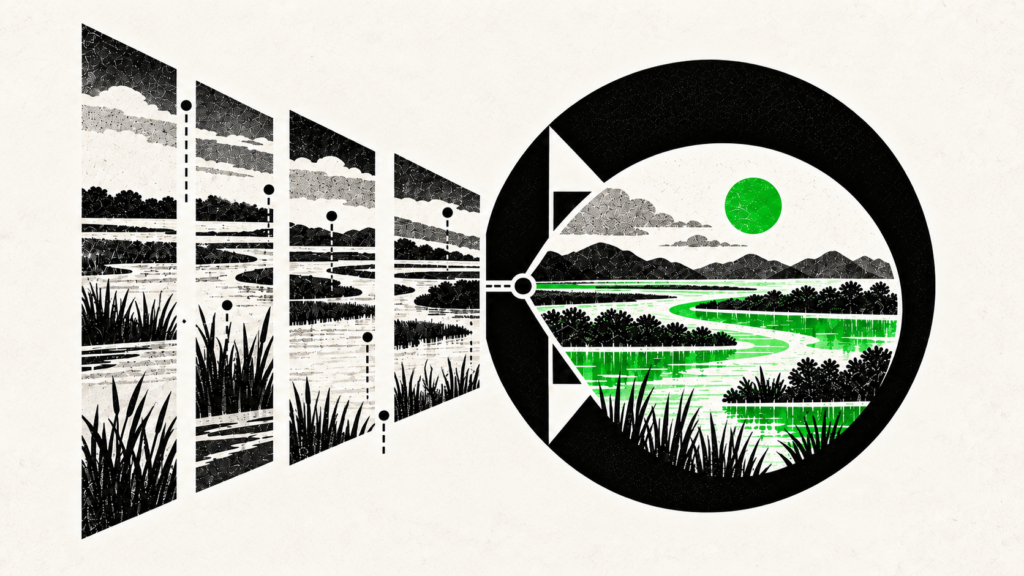
An interactive timeline lets someone compare seasons or years while keeping the data’s source and limitations visible. The goal is pattern recognition, not a cinematic before-and-after.
Reveal relationships. A web or installation experience can show how water, vegetation, species and human activity connect, letting a user follow one thread instead of the whole system at once.
Location-based AR can tie a viewpoint to historical imagery or restoration activity. It is useful when it deepens attention to the real place rather than covering it with spectacle.
Let people examine a real choice. A browser-based scenario can present an actual planning trade-off with the available information intact, rather than simplifying it into a game with one hidden correct answer.
Data still needs permission, not just access
Availability doesn’t make a dataset self-explanatory, and First Nations knowledge in particular can’t be treated as another content layer. Who has authority over what’s shared is a design question from the start, not a legal step at the end.
Where this fits
National parks and visitor centres, museums and aquariums, schools and field education, local-government consultation, corporate sustainability programmes, and conservation campaigns are the natural home for this work.
Start smaller than the ecosystem
A sensible pilot covers one audience, one location, one relationship and one intended response. A lightweight web build can test the story before any investment in AR, VR or a permanent installation.
For Australian conservation and education organisations, MaskMantle can scope a focused pilot, built with the people who hold the local knowledge, not around them.