Most conservation content fails at the exact point where facts stop being enough. Reports, maps, species profiles and campaign materials can be entirely accurate and an audience can still struggle to grasp scale, interdependence or gradual change. A habitat is not a list of species. A coastline is not one photograph. A conservation decision can carry consequences that surface years later, or somewhere far from the person reading about it.
What interaction actually adds
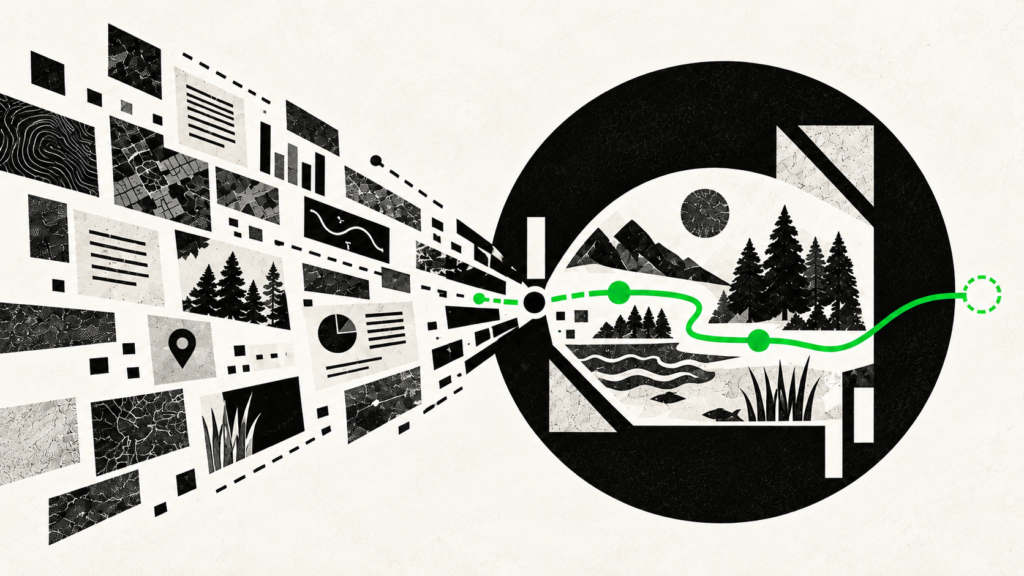
Interactive experiences let someone compare conditions over time, trace a species’ journey or see how one change moves through a wider system. This turns an abstract explanation into something the audience can actively work through. That doesn’t mean every subject needs a headset. A mobile web story, a touch-screen map, an AR layer or a guided installation is often the more accessible answer.
Start with what the audience should be able to do
“Raise awareness” doesn’t give a design team anything to build toward. A sharper brief specifies the actual outcome:
- Recognise why a specific habitat matters
- Understand how pressures accumulate over time
- See the link between ecological health and daily life
- Navigate a real conservation trade-off without oversimplifying it
- Know which action or source to pursue next
Keep the science honest
Immersive media can produce striking imagery, but that isn’t the same as understanding. A dramatic animal encounter can leave the actual ecological relationship unexplained. The experience needs to stay clear about what’s measured, reconstructed or illustrative, and conservation scientists, First Nations knowledge holders and local communities should shape the content and permissions from day one, not review it at the end.
Design for more than one visitor
A visitor centre serves children, tourists, researchers and decision-makers in the same room. Layered design gives each a way in without flattening the subject for everyone else. Accessibility matters just as much. A headset-only experience quietly excludes people by age, comfort or supervision needs, while shared screens, audio, captions and web access widen who can actually take part.
Point to something afterward
Attention isn’t the finish line. The experience should connect to a citizen-science programme, a restoration initiative or a concrete next resource. The next step should be proportionate. Guilt without a real next step doesn’t move anyone. Visitor numbers show reach; they don’t show whether the central relationship landed. Short prompts, facilitated discussion and follow-up participation say more than a headcount ever will.
MaskMantle Studio develops interactive experiences alongside the scientists and communities who understand the environments, challenges and stories being represented.