
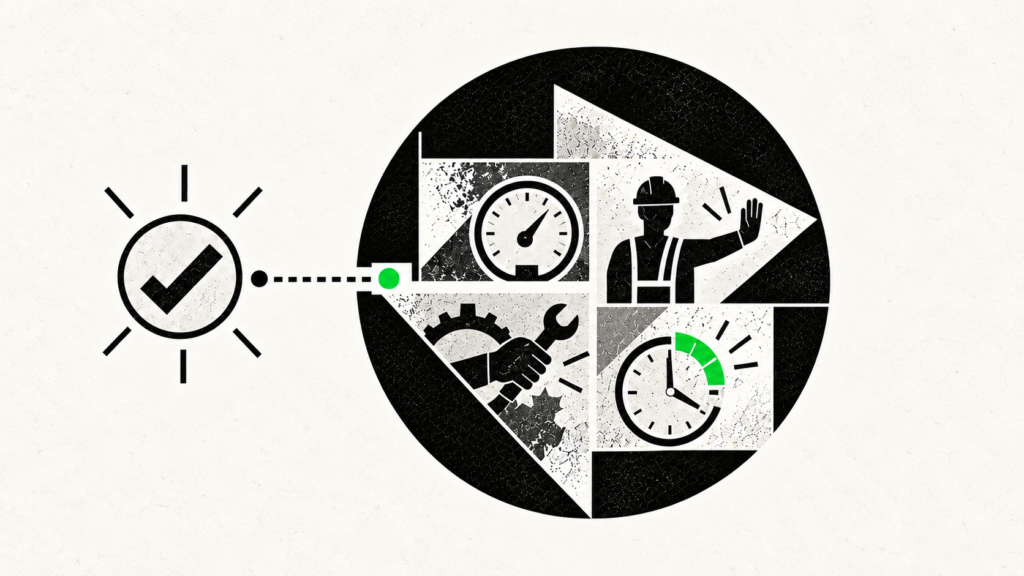
In formal training, the hazard is usually already identified and the answer options are visible. At work, the signal is subtler. A sound changes, a reading drifts, a route gets crowded, a colleague does something unexpected. The worker has to notice that the situation deserves attention before any rule can apply. That’s why recall and recognition are different skills: someone can state a rule perfectly when asked and still miss the exact moment it applies.
Safety decisions rarely happen in isolation from the rest of the job. Time pressure, customer expectations and the behaviour of others are usually part of the same moment. A technically correct response can feel socially awkward or operationally inconvenient in real time, and training that strips out that pressure teaches the rule without preparing the actual decision.
What a useful safety scenario should practise
- Noticing early cues before the emergency becomes obvious
- Pausing or stopping work when the information isn’t enough
- Choosing between continuing, correcting and escalating
- Communicating clearly across roles under time pressure
- Adapting when the usual route or tool isn’t available
- Recovering safely after an initial mistake
These scenarios need to be developed with safety specialists and operators who understand the actual work. A creative team can shape the experience, but shouldn’t be inventing operating rules.
Feedback is what turns interaction into training
An experience isn’t educational just because it’s interactive. The learner needs to understand which cue mattered and what a stronger call would have looked like. Immediate correction suits procedural points; for judgment, letting the consequence unfold and debriefing afterward often teaches more. Repeating the scenario with a changed condition stops people from succeeding through memorisation.
Simulation is one layer, not the whole system
No simulation compensates for unsafe equipment, thin supervision or a culture that discourages reporting. Under Australian model WHS guidance, organisations must eliminate risks, or minimise them so far as is reasonably practicable. In the US, OSHA’s General Duty Clause requires employers to keep workplaces free from recognised serious hazards, while NIOSH’s hierarchy places elimination, substitution and engineering controls above administrative measures such as training. Simulation supports these responsibilities; it does not replace them. Useful simulation data, like missed cues, time to intervene and escalation choices, tells trainers where more coaching is needed; it isn’t proof of workplace competence on its own. Observation and supervision still do that job.
MaskMantle works with operational and safety teams to turn real decision points into rehearsable VR, AR and web practice, not generic hazard-spotting demos.
Practise the decision before it becomes the incident.