
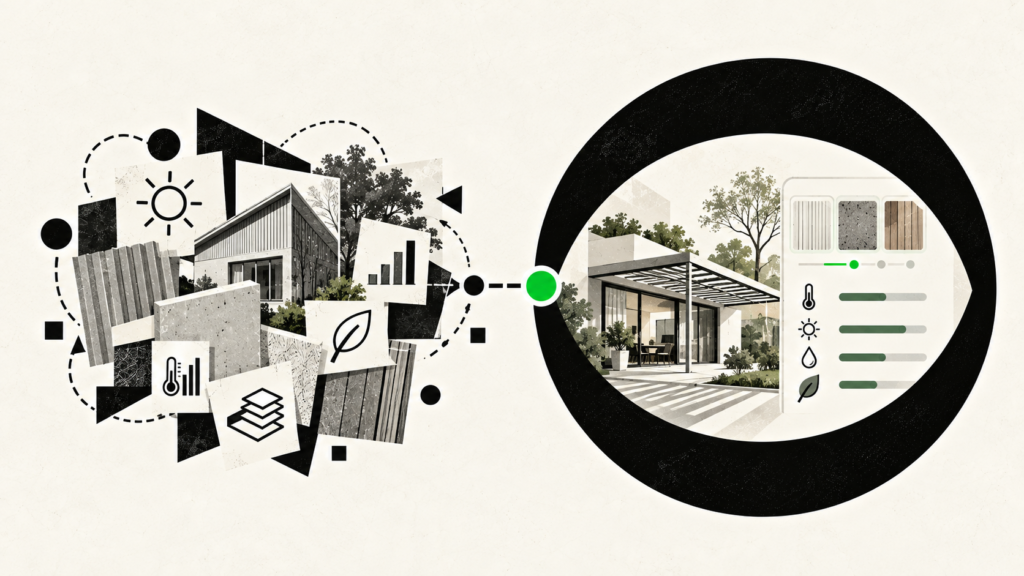
Using building products and design choices to show how interactive experiences can make practical benefits easier to understand.
A building material may promise better insulation, longer-lasting protection or reduced cooling costs. But what do those benefits actually mean to someone choosing between products?
Specifications explain properties. Brochures highlight advantages. Architects and engineers interpret technical implications. Yet the difference a product might make in an actual building can remain difficult to picture.
Imagine being able to explore that difference: compare roof treatments, examine wall materials, introduce shading or see how exterior finishes respond to different conditions. Instead of simply receiving a product claim, customers could investigate what changes, why it changes and whether that difference matters to them.
That’s where interactive storytelling becomes useful.
Beyond the sustainability label
Sustainable construction is often communicated through certifications, environmental commitments and promises of lower energy consumption. But the questions people bring to a building project are usually more practical.
A homeowner may want better comfort and manageable electricity bills. A commercial developer or building owner may weigh construction costs against long-term operating expenses. Architects and engineers must consider performance, suitability and competing requirements.
For manufacturers, there’s another challenge: explaining these advantages to customers and the trade professionals who influence their decisions.
A dealer, contractor, installer or other trade professional may need to explain why one product is suitable, how it differs from alternatives and whether its additional cost is justified.
Consider reflective roofing, insulation or window shading. Depending on the application, these can help reduce heat gain, improve comfort or lower cooling requirements. But climate, design, installation and usage influence the outcome.
Australian passive-design guidance emphasises how material and design choices depend on local conditions; India’s residential energy-efficiency framework similarly considers building-envelope performance.
The value isn’t simply in calling a choice sustainable. It’s in helping people understand what it can achieve, and under which conditions.
What if customers could explore the alternatives?
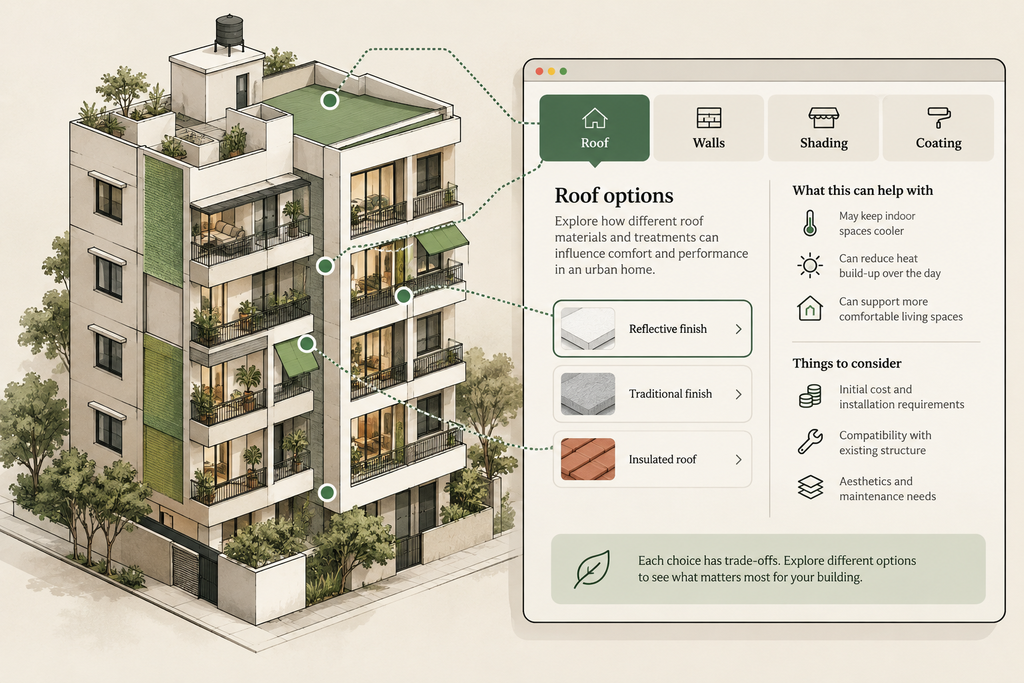
Imagine a browser-based model of a familiar mid-rise Indian residential building.
A material that helps in one climate or building configuration may offer different benefits, or even create disadvantages, elsewhere. Making those conditions visible is part of what gives the comparison value.
A visitor selects a roof treatment and sees an explanation of how it affects heat absorption. They explore shading or wall materials and discover how those choices might influence comfort and cooling demand.
The same principle extends beyond building design.
An exterior paint manufacturer could demonstrate differences in colour retention, weather resistance or moisture protection, using verified test information to illustrate performance under relevant conditions.
A cement manufacturer could explain how different cement grades and specified concrete mixes relate to intended applications, while acknowledging that structural performance depends on the complete construction system.
A property developer could explain the thinking behind particular design decisions. An architect could use a reusable comparison tool to help clients examine alternatives.
These experiences wouldn’t replace product testing, specifications or professional advice. They would help people understand the evidence already available.
Beyond the product claim, customers and trade professionals could explore not only what changes, but why.
Turning technical information into something useful
An effective interactive experience needn’t reveal everything at once.
It can begin with a familiar concern, introduce relevant options, explain their differences and allow people to investigate consequences and trade-offs.
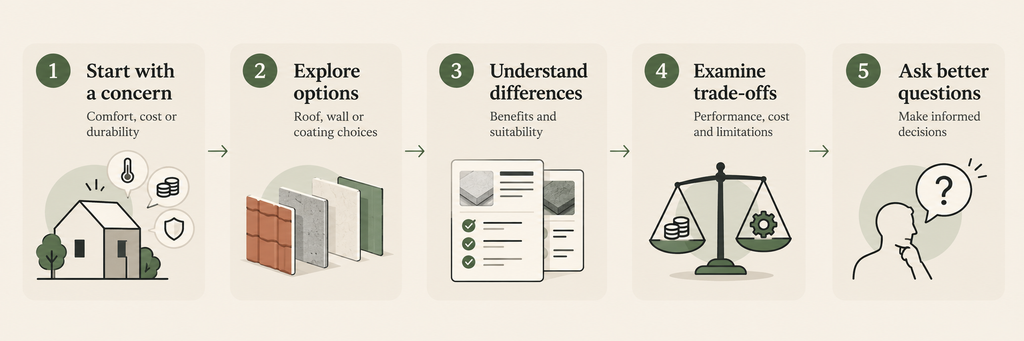
For someone concerned about summer comfort, the experience might begin with roof treatment, then invite them to explore insulation, shading or ventilation.
Each step introduces one consideration and its potential benefits or limitations. Small challenges, comparisons or immediate feedback can encourage further exploration without turning the experience into a conventional game.
This progressive approach makes complex information easier to navigate while allowing visitors to explore further when they want more detail.
A commercial buyer might begin with operating costs. Someone comparing paints might investigate fading or moisture exposure. A dealer, installer or other trade professional could demonstrate the same information on a phone during a customer conversation, while a retail customer could explore it independently.
We’ve explored a related approach in browser-based interactive work, using participation to make complex choices easier to examine.
And it doesn’t require a VR headset. A thoughtfully designed website, comparison tool or browser-based 3D experience may be entirely sufficient.
The medium should follow the communication problem, not the other way around.
Making the invisible difference visible
Interaction is most valuable when it helps people understand something that would otherwise be difficult to explain.
That’s especially relevant when product benefits aren’t immediately visible, or when customers are sceptical of marketing claims.
A more expensive material may offer meaningful long-term value. Or a simpler alternative may be entirely adequate. A credible experience should help people understand both possibilities rather than make every choice lead to the manufacturer’s preferred conclusion.
Nor should an attractive demonstration be mistaken for proof. Performance claims still require reliable testing and appropriate technical evidence. And sometimes a clear diagram or comparison table is enough.
Good insulation doesn’t announce itself. The durability of an exterior coating may only become apparent after years of exposure. Yet such qualities can influence comfort, maintenance and costs long after purchase.
For building-product manufacturers, developers, architects and the trade networks connecting them with customers, interactive storytelling offers a way to make those less visible qualities understandable before a decision is made.
Because showing customers how and why a product works can be far more meaningful than simply telling them it works.
Further reading & references
1. Progressive Disclosure — Nielsen Norman Group
https://www.nngroup.com/articles/progressive-disclosure/
2. YourHome: Passive Cooling — Australian Government
https://www.yourhome.gov.au/passive-design/passive-cooling
3. YourHome: Thermal Mass — Australian Government
https://www.yourhome.gov.au/passive-design/thermal-mass
4. Eco Niwas Samhita — Bureau of Energy Efficiency, India
https://beeindia.gov.in/
5. Guide to Cool Roofs — U.S. Department of Energy
https://www.energy.gov/sites/prod/files/guide_to_cool_roofs.pdf
6. Comparison Tables — Nielsen Norman Group
https://www.nngroup.com/articles/comparison-tables/