
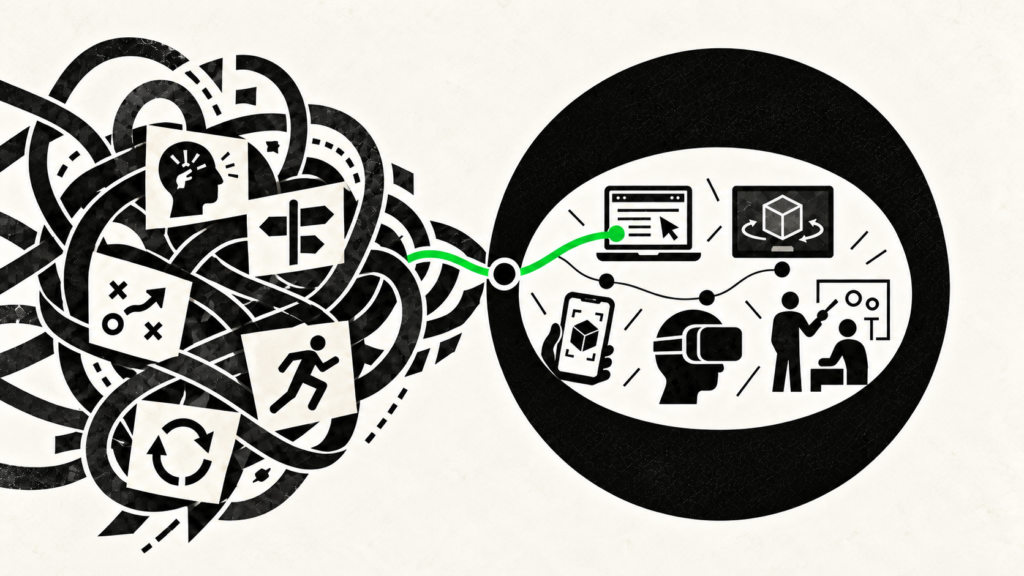
Headsets create presence and spatial understanding, but they also add device management, facilitation and accessibility questions that a browser link simply doesn’t have. Sometimes that trade-off is worth it. Sometimes it isn’t.
Separate the learning problem into four parts: the cue someone must notice, the decision they must make, the action they must perform, and the feedback they need. How much space, movement and physical handling matter usually points straight to the right format.
Browser-based branching scenarios
Browser-based branching scenarios work well for situations that require judgement, such as responding to a customer, choosing an escalation path or managing an exception. The advantage is reach and easy updating across a distributed team; the limitation is that it can’t reproduce spatial presence or physical action.
Interactive 3D
Interactive 3D allows someone to explore a product or process on a screen. This can be useful for equipment familiarisation or exploring unbuilt spaces where full immersion may help but isn’t essential.
Augmented reality
Augmented reality earns its place when digital information genuinely needs to sit within the real world, whether to overlay a process, guide an inspection or place an object at scale. Its usefulness drops fast in glare, noise or a network-constrained site, whatever the demo looked like in a controlled room.
Virtual reality
Virtual reality is strongest when someone needs to scan an environment, move through a sequence or rehearse something dangerous or inaccessible. The case weakens quickly when the task mainly involves reading or choosing between text options. High visual fidelity doesn’t rescue weak instructional design.
Physical and instructor-led practice
Physical and instructor-led practice remain essential for experiencing real tool resistance, understanding material behaviour and conducting formal assessments. An instructor can recognise hesitation and adapt in ways a fixed simulation cannot.
A practical selection test
- Choose web when reach and decision logic matter more than presence
- Choose interactive 3D when exploration and explanation matter
- Choose AR when the real environment has to stay visible
- Choose VR when spatial presence and safe rehearsal are central
- Choose physical practice when real handling or verified competence is required
MaskMantle designs across VR, AR, interactive 3D and web, starting from the decision that needs practising rather than a device chosen in advance.
Start with the decision that needs practising. Then choose the format that supports it.